Showing posts with label nasa science research. Show all posts

Thursday, July 7, 2011

NASA's Hubble Makes One Millionth Science Observation

NASA's Hubble Space Telescope crossed another milestone in its space odyssey of exploration and discovery. On Monday, July 4, the Earth-orbiting observatory logged its one millionth science observation during a search for water in an exoplanet's atmosphere 1,000 light-years away.

"For 21 years Hubble has been the premier space science observatory, astounding us with deeply beautiful imagery and enabling ground-breaking science across a wide spectrum of astronomical disciplines," said NASA Administrator Charles Bolden. He piloted the space shuttle mission that carried Hubble to orbit. "The fact that Hubble met this milestone while studying a faraway planet is a remarkable reminder of its strength and legacy."

Although Hubble is best known for its stunning imagery of the cosmos, the millionth observation is a spectroscopic measurement, where light is divided into its component colors. These color patterns can reveal the chemical composition of cosmic sources.

Hubble's millionth exposure is of the planet HAT-P-7b, a gas giant planet larger than Jupiter orbiting a star hotter than our sun. HAT-P-7b, also known as Kepler 2b, has been studied by NASA's planet-hunting Kepler observatory after it was discovered by ground-based observations. Hubble now is being used to analyze the chemical composition of the planet’s atmosphere.
"We are looking for the spectral signature of water vapor. This is an extremely precise observation and it will take months of analysis before we have an answer," said Drake Deming of the University of Maryland and NASA's Goddard Space Flight Center in Greenbelt, Md. "Hubble demonstrated it is ideally suited for characterizing the atmospheres of exoplanets, and we are excited to see what this latest targeted world will reveal."

Hubble was launched April 24, 1990, aboard space shuttle's Discovery's STS-31 mission. Its discoveries revolutionized nearly all areas of astronomical research from planetary science to cosmology. The observatory has collected more than 50 terabytes of data to-date.

Hubble's odometer reading includes every observation of astronomical targets since its launch and observations used to calibrate its suite of instruments. Hubble made the millionth observation using its Wide Field Camera 3, a visible and infrared light imager with an on-board spectrometer. It was installed by astronauts during the Hubble Servicing Mission 4 in May 2009.

"The Hubble keeps amazing us with groundbreaking science," said Sen. Barbara A. Mikulski, the chairwoman of the Senate Commerce, Justice, Science and Related Agencies Appropriations Subcommittee that funds NASA. "I championed the mission to repair and renew Hubble not just to get one million science observations, but also to inspire millions of children across the planet to become our next generation of stargazers, scientists, astronauts and engineers."

Hubble is a project of international cooperation between NASA and the European Space Agency. Goddard manages the telescope. The Space Telescope Science Institute (STScI) conducts Hubble science operations. STScI is operated for NASA by the Association of Universities for Research in Astronomy Inc. in Washington.

Tuesday, June 28, 2011

Tiny Satellite to be designed by the students of Merritt Island High School

A group of 12 students from Merritt Island High School are participating in Kennedy Space Center's Creating Understanding and Broadening Education through Satellite (CUBES) pilot project. One day soon they may see the tiny satellite they design, called a CubeSat, fly as a secondary payload with a university satellite on one of NASA's expendable launch vehicle missions.


The CUBES project, developed and implemented by Kennedy's Foundations of Leadership Team, is spearheaded by the center's Education Programs Office. The Launch Services Program (LSP) is sponsoring the project and providing the CubeSat kits and additional support material.

Merritt Island is only the second high school in the country, and the first in Florida, to design and build a CubeSat.


Danielle, an incoming senior and CUBES project manager, said she heard about the project through the school's science club and wanted to get involved because it was truly an opportunity of a lifetime.

"I've lived next to the space center my entire life so it is a dream come true to be able to partner with engineers to design, construct and launch a satellite," Danielle said.

Erin, also an incoming senior said she heard about the project through the school's engineering club, as did many of the other students who signed up. Erin readied the preliminary system requirements for review.

"I really wanted to get involved because it seemed like something unique and different than anything else at the school," Erin said. "I knew it would be a great learning experience."

Kennedy mentor Shaun Daly from the Engineering Directorate, is the programmatic manager and liaison to the LSP. He said the mentors are equally excited about the potential to be involved in the development of a CubeSat.

"We hold ourselves to a promise that the students run this project," Daly said. "We will continue to enable learning while giving guidance where needed, but the students make the end decisions."

After completing the first major milestones, which were delivering a mission concept review and preliminary systems requirements review to NASA and industry personnel in late April, the students received approval to continue on to the design phase.

Danielle said the reviews included an overview of the mission and how the team plans to achieve it. She and other students talked about each subsystem, including power, communication, command and data and the requirements needed for each.

"The CubeSat is a tool to educate," said Garrett Skrobot, who is the LSP PPOD/CubeSat mission manager. "It is a way to encourage high school students to get excited about science, technology, engineering and mathematics (STEM) careers."

Grace Johnson, the CUBES education project manager, said that the tiny satellite's primary mission will be to collect vibration data during the launch, which is one of LSP's goals. The data will be transmitted wirelessly to the university satellite also on the mission, and then from there to Earth.

"This is potentially the beginning of a series of missions that could support that effort," Johnson said. "It's also a way to show that high school students can design and build a small satellite."

Danielle said that LSP requirements need to be changed in order to allow the CubeSat to be powered on during launch for data transmission. Normally, secondary payloads must be powered off so they don't interfere with the primary satellite during launch.

According to Alison Fertig, a physics teacher and project advisor, the students will meet during the summer to redefine requirements and work on their trades. She hopes the students will be able to travel to Utah State University at the beginning of August for the Small Satellite Conference and a CubeSat workshop facilitated by California Polytechnic University.

Daly and several other mentors are exceptionally proud of the work the students already accomplished and also are impressed with the innovative solutions they developed to meet tough engineering challenges in the beginning design phase of the project.

"There is much to come," Daly said. "We expect great things from the students and I am sure they will deliver in a big way."

Wednesday, June 22, 2011

THE NEXT BIG SOLAR SYSTEM


June 21, 2011: In Sept. 1859, on the eve of a below-average solar cycle, the sun unleashed one of the most powerful storms in centuries. The underlying flare was so unusual, researchers still aren't sure how to categorize it. The blast peppered Earth with the most energetic protons in half-a-millennium, induced electrical currents that set telegraph offices on fire, and sparked Northern Lights over Cuba and Hawaii.

This week, officials have gathered at the National Press Club in Washington DC to ask themselves a simple question: What if it happens again?

"A similar storm today might knock us for a loop," says Lika Guhathakurta, a solar physicist at NASA headquarters. "Modern society depends on high-tech systems such as smart power grids, GPS, and satellite communications--all of which are vulnerable to solar storms."

She and more than a hundred others are attending the fifth annual Space Weather Enterprise Forum—"SWEF" for short. The purpose of SWEF is to raise awareness of space weather and its effects on society especially among policy makers and emergency responders. Attendees come from the US Congress, FEMA, power companies, the United Nations, NASA, NOAA and more.

As 2011 unfolds, the sun is once again on the eve of a below-average solar cycle—at least that’s what forecasters are saying. The "Carrington event" of 1859 (named after astronomer Richard Carrington, who witnessed the instigating flare) reminds us that strong storms can occur even when the underlying cycle is nominally weak.

In 1859 the worst-case scenario was a day or two without telegraph messages and a lot of puzzled sky watchers on tropical islands.

In 2011 the situation would be more serious. An avalanche of blackouts carried across continents by long-distance power lines could last for weeks to months as engineers struggle to repair damaged transformers. Planes and ships couldn’t trust GPS units for navigation. Banking and financial networks might go offline, disrupting commerce in a way unique to the Information Age. According to a 2008 report from the National Academy of Sciences, a century-class solar storm could have the economic impact of 20 hurricane Katrinas.

As policy makers meet to learn about this menace, NASA researchers a few miles away are actually doing something about it:

"We can now track the progress of solar storms in 3 dimensions as the storms bear down on Earth," says Michael Hesse, chief of the GSFC Space Weather Lab and a speaker at the forum. "This sets the stage for actionable space weather alerts that could preserve power grids and other high-tech assets during extreme periods of solar activity."

Tuesday, January 11, 2011

NASA'S Kepler Mission Discovers Its First Rocky Planet

NASA's Kepler mission confirmed the discovery of its first rocky planet, named Kepler-10b. Measuring 1.4 times the size of Earth, it is the smallest planet ever discovered outside our solar system.

The discovery of this so-called exoplanet is based on more than eight months of data collected by the spacecraft from May 2009 to early January 2010.

"All of Kepler's best capabilities have converged to yield the first solid evidence of a rocky planet orbiting a star other than our sun," said Natalie Batalha, Kepler's deputy science team lead at NASA's Ames Research Center in Moffett Field, Calif., and primary author of a paper on the discovery accepted by the Astrophysical Journal. "The Kepler team made a commitment in 2010 about finding the telltale signatures of small planets in the data, and it's beginning to pay off."

Kepler's ultra-precise photometer measures the tiny decrease in a star's brightness that occurs when a planet crosses in front of it. The size of the planet can be derived from these periodic dips in brightness. The distance between the planet and the star is calculated by measuring the time between successive dips as the planet orbits the star.


Monday, December 6, 2010

NASA Aids in Characterizing Super-Earth Atmosphere


A team of astronomers, including two NASA Sagan Fellows, has made the first characterizations of a super-Earth's atmosphere, by using a ground-based telescope. A super-Earth is a planet up to three times the size of Earth and weighing up to 10 times as much. The findings, reported in the Dec. 2 issue of the journal Nature, are a significant milestone toward eventually being able to probe the atmospheres of Earth-like planets for signs of life.

The team determined the planet, GJ 1214b, is either blanketed with a thin layer of water steam or surrounded by a thick layer of high clouds. If the former, the planet itself would have an icy composition. If the latter, the planet would be rocky or similar to the composition of Neptune, though much smaller.

"This is the first super-Earth known to have an atmosphere," said Jacob Bean, a NASA Sagan Fellow and astronomer at the Harvard-Smithsonian Center for Astrophysics in Cambridge, Mass. "But even with these new measurements, we can't say yet what that atmosphere is made of. This world is being very shy and veiling its true nature from us."

GJ 1214b, first discovered in December 2009, is 2.7 times the size of Earth and 6.5 times as massive. Previous observations of the planet's size and mass demonstrated it has a low density for its size, leading astronomers to conclude the planet is some kind of solid body with an atmosphere.

The planet orbits close to its dim star, at a distance of 0.014 astronomical units. An astronomical unit is the distance between Earth and the sun, approximately 93 million miles. GJ 1214b circles too close to its star to be habitable by any life forms.

Bean and his team observed infrared light as the planet crossed in front of its star. During such transits, the star's light filters through the atmosphere. Gases absorb the starlight at particular wavelengths, leaving behind chemical fingerprints detectable from Earth. This same type of technique has been used to study the atmospheres of distant "hot Jupiters," or Jupiter-like planets orbiting close to their stars, and found gases like hydrogen, methane and sodium vapor.

In the case of the super-Earth, no chemical fingerprints were detected; however, this doesn't mean there are no chemicals present. Instead, this information ruled out some possibilities for GJ 1214b's atmosphere, and narrowed the scope to either an atmosphere of water steam or high clouds. Astronomers believe it's more likely the atmosphere is too thin around the planet to let enough light filter through and reveal chemical fingerprints.

"A steamy atmosphere would have to be very dense – about one-fifth water vapor by volume -- compared to our Earth, with an atmosphere that's four-fifths nitrogen and one-fifth oxygen with only a touch of water vapor," Bean said. "During the next year, we should have some solid answers about what this planet is truly like."

The team, which included Bean's co-authors -- Eliza Miller-Ricci Kempton, a NASA Sagan Fellow at the University of California in Santa Cruz, and Derek Homeier of the Institute for Astrophysics in Gottingen, Germany -- examined GJ 1214b using the ground-based Very Large Telescope at Paranal Observatory in Chile.

"This is an important step forward, narrowing our understanding of the atmosphere of this planet," said NASA Exoplanet Exploration Program Scientist Douglas Hudgins at NASA Headquarters in Washington. "Bizarre worlds like this make exoplanet science one of the most compelling areas in astrophysics today."

The Sagan Fellowship Program is administered by the NASA Exoplanet Science Institute at the California Institute of Technology in Pasadena. Its purpose is to advance the scientific and technical goals of NASA's Exoplanet Exploration Program. The program is managed for NASA by the Jet Propulsion Laboratory in Pasadena, Calif. Caltech manages JPL for NASA.

More information about NASA's planet-finding missions is online at:http://planetquest.jpl.nasa.gov . More information about NASA's Sagan Fellowship Program is at http://nexsci.caltech.edu/sagan .

Saturday, December 4, 2010

Cassini Returns Images of Bright Jets at Enceladus


NASA's Cassini spacecraft successfully dipped near the surface of Saturn's moon Enceladus on Nov. 30. Though Cassini's closest approach took it to within about 48 kilometers (30 miles) of the moon's northern hemisphere, the spacecraft also captured shadowy images of the tortured south polar terrain and the brilliant jets that spray out from it.

Many of the raw images feature darkened terrain because winter has descended upon the southern hemisphere of Enceladus. But sunlight behind the moon backlights the jets of water vapor and icy particles. In some images, the jets line up in rows, forming curtains of spray.

The new raw images can be seen at http://saturn.jpl.nasa.gov/photos/raw/ .

The Enceladus flyby was the 12th of Cassini's mission, with the spacecraft swooping down around 61 degrees north latitude. This encounter and its twin three weeks later at the same altitude and latitude, are the closest Cassini will come to the northern hemisphere surface of Enceladus during the extended Solstice mission. (Cassini's closest-ever approach to Enceladus occurred in October 2008, when the spacecraft dipped to an altitude of 25 kilometers, or 16 miles.)

Among the observations Cassini made during this Enceladus flyby, the radio science subsystem collected gravity measurements to understand the moon's interior structure, and the fields and particles instruments sampled the charged particle environment around the moon.

About two days before the Enceladus flyby, Cassini also passed the sponge-like moon Hyperion, beaming back intriguing images of the craters on its surface. The flyby, at 72,000 kilometers (45,000 miles) in altitude, was one of the closest approaches to Hyperion that Cassini has made.

Scientists are still working to analyze the data and images collected during the flybys.

The Cassini-Huygens mission is a cooperative project of NASA, the European Space Agency and the Italian Space Agency. The Jet Propulsion Laboratory manages the project for NASA's Science Mission Directorate in Washington. The Cassini orbiter was designed, developed and assembled at JPL. The imaging operations center is based at the Space Science Institute in Boulder, Colo.

More Cassini information is available, at t http://www.nasa.gov/cassini and http://saturn.jpl.nasa.gov .

Tuesday, November 30, 2010

Thin Air - Cassini Finds Ethereal Atmosphere at Rhea

NASA's Cassini spacecraft has detected a very tenuous atmosphere known as an exosphere, infused with oxygen and carbon dioxide around Saturn's icy moon Rhea. This is the first time a spacecraft has directly captured molecules of an oxygen atmosphere – albeit a very thin one -- at a world other than Earth.


The oxygen appears to arise when Saturn's magnetic field rotates over Rhea. Energetic particles trapped in the planet's magnetic field pepper the moon’s water-ice surface. They cause chemical reactions that decompose the surface and release oxygen. The source of the carbon dioxide is less certain.

Oxygen at Rhea's surface is estimated to be about 5 trillion times less dense than what we have at Earth. But the new results show that surface decomposition could contribute abundant molecules of oxygen, leading to surface densities roughly 100 times greater than the exospheres of either Earth's moon or Mercury. The formation of oxygen and carbon dioxide could possibly drive complex chemistry on the surfaces of many icy bodies in the universe.

"The new results suggest that active, complex chemistry involving oxygen may be quite common throughout the solar system and even our universe," said lead author Ben Teolis, a Cassini team scientist based at Southwest Research Institute in San Antonio. "Such chemistry could be a prerequisite for life. All evidence from Cassini indicates that Rhea is too cold and devoid of the liquid water necessary for life as we know it."

Releasing oxygen through surface irradiation could help generate conditions favorable for life at an icy body other than Rhea that has liquid water under the surface, Teolis said. If the oxygen and carbon dioxide from the surface could somehow get transported down to a sub-surface ocean, that would provide a much more hospitable environment for more complex compounds and life to form. Scientists are keen to investigate whether life on icy moons with an ocean is possible, though they have not yet detected it.

The tenuous atmosphere with oxygen and carbon dioxide makes Rhea, Saturn's second largest moon, unique in the Saturnian system. Titan has a thick nitrogen-methane atmosphere, but very little carbon dioxide and oxygen.

"Rhea is turning out to be much more interesting than we had imagined," said Linda Spilker, Cassini project scientist at NASA's Jet Propulsion Laboratory, Pasadena, Calif. "The Cassini finding highlights the rich diversity of Saturn’s moons and gives us clues on how they formed and evolved."

Scientists had suspected Rhea could have a thin atmosphere with oxygen and carbon dioxide, based on remote observations of Jupiter's icy moons by NASA's Galileo spacecraft and Hubble Space Telescope. Other Cassini observations detected oxygen escaping from icy Saturn ring particles after ultraviolet bombardment. But Cassini was able to detect oxygen and carbon dioxide in the exosphere directly because of how close it flew to Rhea – 101 kilometers, or 63 miles – and its special suite of instruments.

In the new study, scientists combined data from Cassini's ion and neutral mass spectrometer and the Cassini plasma spectrometer during flybys on Nov. 26, 2005, Aug. 30, 2007, and March 2, 2010. The ion and neutral mass spectrometer "tasted" peak densities of oxygen of around 50 billion molecules per cubic meter (1 billion molecules per cubic foot). It detected peak densities of carbon dioxide of around 20 billion molecules per cubic meter (about 600 million molecules per cubic foot).

The plasma spectrometer saw clear signatures of flowing streams of positive and negative ions, with masses that corresponded to ions of oxygen and carbon dioxide.

"How exactly the carbon dioxide is released is still a puzzle," said co-author Geraint Jones, a Cassini team scientist based at University College London in the U.K. "But with Cassini's diverse suite of instruments observing Rhea from afar, as well as sniffing the gas surrounding it, we hope to solve the puzzle."

The carbon dioxide may be the result of “dry ice” trapped from the primordial solar nebula, as is the case with comets, or it may be due to similar irradiation processes operating on the organic molecules trapped in the water ice of Rhea. The carbon dioxide could also come from carbon-rich materials deposited by tiny meteors that bombarded Rhea's surface.

The Cassini-Huygens mission is a cooperative project of NASA, the European Space Agency, and the Italian Space Agency. NASA's Jet Propulsion Laboratory, Pasadena, Calif., a division of the California Institute of Technology in Pasadena, manages the mission for NASA's Science Mission Directorate, Washington, D.C. The Cassini orbiter was designed, developed and assembled at JPL. The ion and neutral mass spectrometer team and the Cassini plasma spectrometer team are based at Southwest Research Institute, San Antonio.

For more information about the Cassini mission, visit: http://www.nasa.gov/cassini and http://saturn.jpl.nasa.gov .

Friday, November 26, 2010

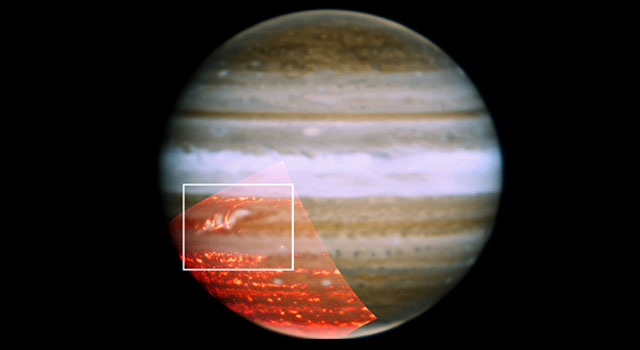
Stripes Are Back in Season on Jupiter


New NASA images support findings that one of Jupiter's stripes that "disappeared" last spring is now showing signs of a comeback. These new observations will help scientists better understand the interaction between Jupiter's winds and cloud chemistry.

Earlier this year, amateur astronomers noticed that a longstanding dark-brown stripe, known as the South Equatorial Belt, just south of Jupiter's equator, had turned white. In early November, amateur astronomer Christopher Go of Cebu City, Philippines, saw an unusually bright spot in the white area that was once the dark stripe. This phenomenon piqued the interest of scientists at NASA's Jet Propulsion Laboratory, Pasadena, Calif., and elsewhere.

After follow-up observations in Hawaii with NASA's Infrared Telescope Facility, the W.M. Keck Observatory and the Gemini Observatory telescope, scientists now believe the vanished dark stripe is making a comeback.

First-glimpse images of the re-appearing stripe are online at: http://www.nasa.gov/topics/solarsystem/features/jupiter20101124-i.html.

"The reason Jupiter seemed to 'lose' this band - camouflaging itself among the surrounding white bands - is that the usual downwelling winds that are dry and keep the region clear of clouds died down," said Glenn Orton, a research scientist at JPL. "One of the things we were looking for in the infrared was evidence that the darker material emerging to the west of the bright spot was actually the start of clearing in the cloud deck, and that is precisely what we saw."

This white cloud deck is made up of white ammonia ice. When the white clouds float at a higher altitude, they obscure the missing brown material, which floats at a lower altitude. Every few decades or so, the South Equatorial Belt turns completely white for perhaps one to three years, an event that has puzzled scientists for decades. This extreme change in appearance has only been seen with the South Equatorial Belt, making it unique to Jupiter and the entire solar system.

The white band wasn't the only change on the big, gaseous planet. At the same time, Jupiter's Great Red Spot became a darker red color. Orton said the color of the spot - a giant storm on Jupiter that is three times the size of Earth and a century or more old - will likely brighten a bit again as the South Equatorial Belt makes its comeback.

The South Equatorial Belt underwent a slight brightening, known as a "fade," just as NASA's New Horizons spacecraft was flying by on its way to Pluto in 2007. Then there was a rapid "revival" of its usual dark color three to four months later. The last full fade and revival was a double-header event, starting with a fade in 1989, revival in 1990, then another fade and revival in 1993. Similar fades and revivals have been captured visually and photographically back to the early 20th century, and they are likely to be a long-term phenomenon in Jupiter's atmosphere.

Scientists are particularly interested in observing this latest event because it's the first time they've been able to use modern instruments to determine the details of the chemical and dynamical changes of this phenomenon. Observing this event carefully may help to refine the scientific questions to be posed by NASA's Juno spacecraft, due to arrive at Jupiter in 2016, and a larger, proposed mission to orbit Jupiter and explore its satellite Europa after 2020.

The event also signifies another close collaboration between professional and amateur astronomers. The amateurs, located worldwide, are often well equipped with instrumentation and are able to track the rapid developments of planets in the solar system. These amateurs are collaborating with professionals to pursue further studies of the changes that are of great value to scientists and researchers everywhere.

"I was fortunate to catch the outburst," said Christopher Go, referring to the first signs that the band was coming back. "I had a meeting that evening and it went late. I caught the outburst just in time as it was rising. Had I imaged earlier, I would not have caught it," he said. Go, who also conducts in the physics department at the University of San Carlos, Cebu City, Philippines, witnessed the disappearance of the stripe earlier this year, and in 2007 he was the first to catch the stripe's return. "I was able to catch it early this time around because I knew exactly what to look for."

NASA's Exoplanet Science Institute at the California Institute of Technology in Pasadena manages time allocation on the Keck telescope for NASA. Caltech manages JPL for NASA.

For more information about NASA and agency programs, visit: http://www.nasa.gov/home.

Tuesday, November 16, 2010

Rocks and Stars with Amy: This Asteroid Inspected by #32

Over the course of the nine months we’ve been operating WISE, we’ve observed over 150,000 asteroids and comets of all different types. We had to pick all of these moving objects out of the hundreds of millions of sources observed all over the sky — so you can imagine that sifting through all those stars and galaxies to find the asteroids is not easy!

We use a lot of techniques to figure out how to distinguish an asteroid from a star or galaxy. Even though just about everything in the universe moves, asteroids are a whole lot closer to us than your average star (and certainly your average galaxy), so they appear to move from place to place in the WISE images over a timescale of minutes, unlike the much more distant stars. It’s almost like watching a pack of cyclists go by in the Tour de France. Also, WISE takes infrared images, which means that cooler objects like asteroids look different than the hotter stars. If you look at the picture below, you can see that the stars appear bright blue, whereas the sole asteroid in the frame appears red. That’s because the asteroid is about room temperature and is therefore much colder than the stars, which are thousands of degrees. Cooler objects will give off more of their light at longer, infrared wavelengths that our WISE telescope sees. We can use both of these unique properties of asteroids — their motion and their bright infrared signatures — to tease them out of the bazillions of stars and galaxies in the WISE images.


Thanks to the efforts of some smart scientists and software engineers, we have a very slick program that automatically searches the images for anything that moves at the longer, infrared wavelengths. With WISE, we take about a dozen or so images of each part of the sky over a couple of days. The system works by throwing out everything that appears again and again in each exposure. What’s left are just the so-called transient sources, the things that don’t stay the same between snapshots. Most of these are cosmic rays — charged particles zooming through space that are either spat out by our sun or burped up from other high-energy processes like supernovae or stars falling into black holes. These cosmic rays hit our detectors, leaving a blip that appears for just a single exposure. Also, really bright objects can leave an after-image on the detectors that can persist for many minutes, just like when you stare at a light bulb and then close your eyes. We have to weed the real asteroid detections out from the cosmic rays and after-images.

The data pipeline is smart enough to catch most of these artifacts and figure out what the real moving objects are. However, if it’s a new asteroid that no one has ever seen before, we have to have a human inspect the set of images and make sure that it’s not just a collection of artifacts that happened to show up at the right place and right time. About 20 percent of the asteroids that we observe appear to be new, and we examine those using a program that we call our quality assurance (QA) system, which lets us rapidly sift through hundreds of candidate asteroids to make sure they’re real. The QA system pops up a set of images of the candidate asteroid, along with a bunch of “before” and “after” images of the same part of the sky. This lets us eliminate any stars that might have been confused for the asteroids. Finally, since the WISE camera takes a picture every 11 seconds, we take a look at the exposures taken immediately before the ones with the candidate asteroid — if the source is really just an after-image persisting after we’ve looked at something bright, it will be there in the previous frame. We’ve had many students — three college students and two very talented high school students — work on asteroid QA. They’ve become real pros at inspecting asteroid candidates!


Meanwhile, the hunt continues — we’re still trekking along through the sky with the two shortest-wavelength infrared bands, now that we’ve run out of the super-cold hydrogen that was keeping two of the four detectors operating. Even though our sensitivity is lower, we’re still observing asteroids and looking for interesting things like nearby brown dwarfs (stars too cold to shine in visible light because they can’t sustain nuclear fusion). Our dedicated team of asteroid inspectors keeps plugging away, keeping the quality of the detections very high so that we leave the best possible legacy when our little telescope’s journey is finally done.

Tuesday, November 9, 2010

In the well known Pleiades star cluster, starlight is slowly destroying this wandering cloud of gas and dust. The star Merope lies just off the upper


In the well known Pleiades star cluster, starlight is slowly destroying this wandering cloud of gas and dust. The star Merope lies just off the upper left edge of this picture from the Hubble Space Telescope. In the past 100,000 years, part of the cloud has by chance moved so close to this star--only 3,500 times the Earth-Sun distance--that the starlight itself is having a very dramatic effect. Pressure of the star's light significantly repels the dust in the reflection nebula, and smaller dust particles are repelled more strongly. As a result, parts of the dust cloud have become stratified, pointing toward Merope. The closest particles are the most massive and the least affected by the radiation pressure. A longer-term result will be the general destruction of the dust by the energetic starlight.

In the well known Pleiades star cluster, starlight is slowly destroying this wandering cloud of gas and dust. The star Merope lies just off the upper


In the well known Pleiades star cluster, starlight is slowly destroying this wandering cloud of gas and dust. The star Merope lies just off the upper left edge of this picture from the Hubble Space Telescope. In the past 100,000 years, part of the cloud has by chance moved so close to this star--only 3,500 times the Earth-Sun distance--that the starlight itself is having a very dramatic effect. Pressure of the star's light significantly repels the dust in the reflection nebula, and smaller dust particles are repelled more strongly. As a result, parts of the dust cloud have become stratified, pointing toward Merope. The closest particles are the most massive and the least affected by the radiation pressure. A longer-term result will be the general destruction of the dust by the energetic starlight.

Friday, October 15, 2010

STS-133 Crew Begins Dress Rehearsal


At NASA's Kennedy Space Center in Florida, STS-133 Commander Steve Lindsey speaks to the media gathered at the Shuttle Landing Facility. From left are Nicole Stott, Michael Barratt, Eric Boe, Tim Kopra and Alvin Drew. The crew is gathered for a practice launch dress rehearsal called the Terminal Countdown Demonstration Test (TCDT) in preparation for the upcoming mission. TCDT provides each shuttle crew and launch team with an opportunity to participate in various simulated countdown activities, including equipment familiarization and emergency training. Space shuttle Discovery and its STS-133 crew will deliver the Permanent Multipurpose Module, packed with supplies and critical spare parts, as well as Robonaut 2, the dexterous humanoid astronaut helper, to the International Space Station. Launch is targeted for Nov. 1 at 4:40 p.m.

Tuesday, September 28, 2010

Observe the Moon


This photograph shows the Laser Ranging Facility at the Geophysical and Astronomical Observatory at NASA's Goddard Spaceflight Center in Greenbelt, Md. The observatory helps NASA keep track of orbiting satellites. In this image, the lower of the two green beams is from the Lunar Reconnaissance Orbiter's dedicated tracker. The other laser originates from another ground system at the facility. Both beams are pointed at the moon -- specifically at LRO in orbit around the moon.

Thursday, July 1, 2010

ISS Progress 38 Launches


As the Progress made its way to the orbiting complex Thursday, the Expedition 24 crew members made preparations for its arrival and worked with a variety of science experiments.

Commander Alexander Skvortsov and Flight Engineer Mikhail Kornienko had a conference with specialists on Earth to review docking procedures for the arrival of the Progress.

The Progress is scheduled to dock to the International Space Station using the automated Kurs docking system at 12:58 p.m. Friday.

To make room for the ISS Progress 38, the Expedition 24 crew relocated the Soyuz TMA-19 spacecraft from the aft end of the Zvezda service module to the Rassvet module Monday.

Flight Engineer Doug Wheelock worked with the VO2max experiment, which involves recording the oxygen intake of exercising crew members before, during and after their stays aboard the station to evaluate and document the changes in their aerobic capacity.

Flight Engineer Tracy Caldwell Dyson worked with the Coarsening in Solid-Liquid Mixtures-2 experiment, which studies the way that particles of tin suspended in a molten tin/lead mixture increase in size – a process known as coarsening – without the influence of the Earth’s gravity. This work has direct applications to metal alloy manufacturing on Earth, including materials critical for aerospace applications.


Viewthis site : California Printing,Orange County printing,California Printer,Irvine printing

Thursday, June 17, 2010

New Crew Members Prepare for Docking


Three new Expedition 24 crew members continued their voyage aboard the Soyuz TMA-19 spacecraft to the International Space Station after launching from the Baikonur Cosmodrome in Kazakhstan at 5:35 p.m. EDT Tuesday.

Flight Engineers Doug Wheelock, Shannon Walker and Fyodor Yurchikhin executed another rendezvous burn and tested the docking systems of the Soyuz TMA-19 Wednesday to prepare for docking to the aft port of the station’s Zvezda service module at 6:25 p.m. Thursday.

Fellow Expedition 24 crewmates, Commander Alexander Skvortsov and Flight Engineers Mikhail Kornienko and Tracy Caldwell Dyson, will welcome them aboard the orbiting complex when the hatches open around 9:25 p.m.

Our Powerful Sun


Eight planets and their moons, tens of thousands of asteroids, and trillions of comets revolve around the sun. One of these is our Earth, orbiting the sun at an average distance of about 92,960,000 miles (149,600,000 kilometers). The sun is a huge, glowing ball that provides light, heat, and other energy to our Earth. But our beneficial space neighbor is also capable of some stellar "temper tantrums."

On Thursday, June 17, Dr. David Hathaway, a solar scientist at NASA's Marshall Space Flight Center, will answer your questions about how our sun works and produces phenomena such as sunspots, solar flares, and solar storms -- "hot' topics that have communication and health implications for everyone on Earth.

Joining the chat is easy. Simply visit this page on Thursday, June 17 from 3-4 p.m. EDT. The chat window will open at the bottom of this page starting at 2:30 p.m. EDT. You can log in and be ready to ask questions at 3:00. See you in chat!

Friday, June 4, 2010

Mars Exploration Rover Spirit

Rocks examined by NASA's Spirit Mars Rover hold evidence of a wet, non-acidic ancient environment that may have been favorable for life. Confirming this mineral clue took four years of analysis by several scientists.

An outcrop that Spirit examined in late 2005 revealed high concentrations of carbonate, which originates in wet, near-neutral conditions, but dissolves in acid. The ancient water indicated by this find was not acidic.

NASA's rovers have found other evidence of formerly wet Martian environments. However the data for those environments indicate conditions that may have been acidic. In other cases, the conditions were definitely acidic, and therefore less favorable as habitats for life.

Laboratory tests helped confirm the carbonate identification. The findings were published online Thursday, June 3 by the journal Science.

"This is one of the most significant findings by the rovers," said Steve Squyres of Cornell University in Ithaca, N.Y. Squyres is principal investigator for the Mars twin rovers, Spirit and Opportunity, and a co-author of the new report. "A substantial carbonate deposit in a Mars outcrop tells us that conditions that could have been quite favorable for life were present at one time in that place. "

Thursday, May 27, 2010

Swift Survey Finds 'Smoking Gun' Of Black Hole Activation

The optical counterparts of many active galactic nuclei (circled) detected by the Swift BAT Hard X-ray Survey clearly show galaxies in the process of merging. These images, taken with the 2.1-meter telescope at Kitt Peak National Observatory in Arizona, show galaxy shapes that are either physically intertwined or distorted by the gravity of nearby neighbors. These AGN were known prior to the Swift survey, but Swift has found dozens of new ones in more distant galaxies.

Data from an ongoing survey by NASA's Swift satellite have helped astronomers solve a decades-long mystery about why a small percentage of black holes emit vast amounts of energy.

Only about one percent of supermassive black holes exhibit this behavior. The new findings confirm that black holes "light up" when galaxies collide, and the data may offer insight into the future behavior of the black hole in our own Milky Way galaxy. The study will appear in the June 20 issue of The Astrophysical Journal Letters.

The intense emission from galaxy centers, or nuclei, arises near a supermassive black hole containing between a million and a billion times the sun's mass. Giving off as much as 10 billion times the sun's energy, some of these active galactic nuclei (AGN) are the most luminous objects in the universe. They include quasars and blazars.

"Theorists have shown that the violence in galaxy mergers can feed a galaxy's central black hole," said Michael Koss, the study's lead author and a graduate student at the University of Maryland in College Park. "The study elegantly explains how the black holes switched on."

Monday, May 24, 2010

Heart and Soul

The Heart and Soul nebulae are seen in this infrared mosaic from NASA's Wide-field Infrared Survey Explorer, or WISE. The image covers an area of the sky over ten times as wide as the full moon and eight times as high (5.5 x 3.9 degrees) in the constellation Cassiopeia.

Located about 6,000 light-years from Earth, the Heart and Soul nebulae form a vast star-forming complex that makes up part of the Perseus spiral arm of our Milky Way galaxy. The nebula to the left is the Heart, designated IC 1805 and named after its resemblance to a human heart. To the right is the Soul nebula, also known as the Embryo nebula, IC 1848 or W5. The Perseus arm lies further from the center of the Milky Way than the arm that contains our sun. The Heart and Soul nebulae stretch out nearly 580 light-years across, covering a small portion of the diameter of the Milky Way, which is roughly 100,000 light-years across.

The two nebulae are both massive star-making factories, marked by giant bubbles that were blown into surrounding dust by radiation and winds from the stars. WISE's infrared vision allows it to see into the cooler and dustier crevices of clouds like these, where gas and dust are just beginning to collect into new stars. These stars are less than a few million of years old -- youngsters in comparison to stars like the sun, which is nearly 5 billion years old.

Also visible near the bottom of this image are two galaxies, Maffei 1 and Maffei 2. Both galaxies contain billions of stars and, at about 10 million light-years away, are well outside our Milky Way yet relatively close compared to most galaxies. Maffei 1 is the bluish elliptical object and Maffei 2 is the spiral galaxy.

Thursday, May 6, 2010

Herschel Gets Sneak Peak at Star Birth

The first scientific results from the Herschel infrared space observatory are revealing previously hidden details of star formation. New images show thousands of distant galaxies furiously building stars and beautiful star-forming clouds draped across our Milky Way galaxy. One picture even catches an "impossible" star in the act of formation.

Presented today during a major scientific symposium held at the European Space Agency in the Netherlands, the results challenge old ideas of star birth, and open new roads for future research. The mission is led by the European Space Agency with important participation from NASA.

"Herschel is a new eye on a part of the cosmos that has been dark and buried for a long time," said the mission's NASA project scientist, Paul Goldsmith, at NASA's Jet Propulsion Laboratory, Pasadena, Calif.

Herschel's observation of the star-forming cloud RCW 120 has revealed an embryonic star, which appears ready to turn into one of the biggest and brightest stars in our galaxy within the next few hundred thousand years. It already contains eight to 10 times the mass of the sun and is still surrounded by an additional 2,000 solar masses of gas and dust from which it can feed further.

"This star can only grow bigger," says Annie Zavagno, Laboratoire d'Astrophysique de Marseille in France. Massive stars are rare and short-lived. To catch one during formation presents a golden opportunity to solve a long-standing paradox in astronomy. "According to our current understanding, you should not be able to form stars larger than eight solar masses," says Zavagno.