Showing posts with label NASA space shuttle. Show all posts

Tuesday, November 8, 2011

Space shuttle data leads to better model for solar power production in California


The space shuttle program may have ended, but data the space craft collected over the past three decades are still helping advance science. Researchers at the Jacobs School of Engineering at UC San Diego recently used measurements from NASA's Shuttle Radar Topography Mission to predict how changes in elevation, such as hills and valleys, and the shadows they create, impact power output in California's solar grid.

Current large-scale models used to calculate solar power output do not take elevation into account. The California Public Utilities Commission asked Jan Kleissl, a professor of environmental engineering at the Jacobs School of Engineering at UC San Diego, and postdoctoral researcher Juan Luis Bosch, from the department of mechanical and aerospace engineering, to build a model that does.

This is the first time this kind of model will be made available publicly on such a large scale, including all of Southern California, as well as the San Francisco Bay Area. It took the Triton Supercomputer at the San Diego Supercomputer Center here at UCSD 60,000 processor hours to run calculations for the model. Utility companies and homeowners can use the model to get a more realistic picture of the solar power output they can typically expect to produce. This is an especially important tool for utilities, because it gives them a better idea of how much revenue they can actually generate, Kleissl said.

Changes in elevation can have a significant impact on solar power output. The longer it takes for the sun to rise above the local horizon in the morning and the earlier it sets in the evening, the more solar fuel is lost. Solar days are longest on top of tall mountains. They are shortest in steep valleys oriented north-south, where it can take more than an hour longer for the sun to appear in the east.

Tuesday, January 11, 2011

NASA'S Kepler Mission Discovers Its First Rocky Planet

NASA's Kepler mission confirmed the discovery of its first rocky planet, named Kepler-10b. Measuring 1.4 times the size of Earth, it is the smallest planet ever discovered outside our solar system.

The discovery of this so-called exoplanet is based on more than eight months of data collected by the spacecraft from May 2009 to early January 2010.

"All of Kepler's best capabilities have converged to yield the first solid evidence of a rocky planet orbiting a star other than our sun," said Natalie Batalha, Kepler's deputy science team lead at NASA's Ames Research Center in Moffett Field, Calif., and primary author of a paper on the discovery accepted by the Astrophysical Journal. "The Kepler team made a commitment in 2010 about finding the telltale signatures of small planets in the data, and it's beginning to pay off."

Kepler's ultra-precise photometer measures the tiny decrease in a star's brightness that occurs when a planet crosses in front of it. The size of the planet can be derived from these periodic dips in brightness. The distance between the planet and the star is calculated by measuring the time between successive dips as the planet orbits the star.


Saturday, December 4, 2010

Cassini Returns Images of Bright Jets at Enceladus


NASA's Cassini spacecraft successfully dipped near the surface of Saturn's moon Enceladus on Nov. 30. Though Cassini's closest approach took it to within about 48 kilometers (30 miles) of the moon's northern hemisphere, the spacecraft also captured shadowy images of the tortured south polar terrain and the brilliant jets that spray out from it.

Many of the raw images feature darkened terrain because winter has descended upon the southern hemisphere of Enceladus. But sunlight behind the moon backlights the jets of water vapor and icy particles. In some images, the jets line up in rows, forming curtains of spray.

The new raw images can be seen at http://saturn.jpl.nasa.gov/photos/raw/ .

The Enceladus flyby was the 12th of Cassini's mission, with the spacecraft swooping down around 61 degrees north latitude. This encounter and its twin three weeks later at the same altitude and latitude, are the closest Cassini will come to the northern hemisphere surface of Enceladus during the extended Solstice mission. (Cassini's closest-ever approach to Enceladus occurred in October 2008, when the spacecraft dipped to an altitude of 25 kilometers, or 16 miles.)

Among the observations Cassini made during this Enceladus flyby, the radio science subsystem collected gravity measurements to understand the moon's interior structure, and the fields and particles instruments sampled the charged particle environment around the moon.

About two days before the Enceladus flyby, Cassini also passed the sponge-like moon Hyperion, beaming back intriguing images of the craters on its surface. The flyby, at 72,000 kilometers (45,000 miles) in altitude, was one of the closest approaches to Hyperion that Cassini has made.

Scientists are still working to analyze the data and images collected during the flybys.

The Cassini-Huygens mission is a cooperative project of NASA, the European Space Agency and the Italian Space Agency. The Jet Propulsion Laboratory manages the project for NASA's Science Mission Directorate in Washington. The Cassini orbiter was designed, developed and assembled at JPL. The imaging operations center is based at the Space Science Institute in Boulder, Colo.

More Cassini information is available, at t http://www.nasa.gov/cassini and http://saturn.jpl.nasa.gov .

Tuesday, November 30, 2010

Thin Air - Cassini Finds Ethereal Atmosphere at Rhea

NASA's Cassini spacecraft has detected a very tenuous atmosphere known as an exosphere, infused with oxygen and carbon dioxide around Saturn's icy moon Rhea. This is the first time a spacecraft has directly captured molecules of an oxygen atmosphere – albeit a very thin one -- at a world other than Earth.


The oxygen appears to arise when Saturn's magnetic field rotates over Rhea. Energetic particles trapped in the planet's magnetic field pepper the moon’s water-ice surface. They cause chemical reactions that decompose the surface and release oxygen. The source of the carbon dioxide is less certain.

Oxygen at Rhea's surface is estimated to be about 5 trillion times less dense than what we have at Earth. But the new results show that surface decomposition could contribute abundant molecules of oxygen, leading to surface densities roughly 100 times greater than the exospheres of either Earth's moon or Mercury. The formation of oxygen and carbon dioxide could possibly drive complex chemistry on the surfaces of many icy bodies in the universe.

"The new results suggest that active, complex chemistry involving oxygen may be quite common throughout the solar system and even our universe," said lead author Ben Teolis, a Cassini team scientist based at Southwest Research Institute in San Antonio. "Such chemistry could be a prerequisite for life. All evidence from Cassini indicates that Rhea is too cold and devoid of the liquid water necessary for life as we know it."

Releasing oxygen through surface irradiation could help generate conditions favorable for life at an icy body other than Rhea that has liquid water under the surface, Teolis said. If the oxygen and carbon dioxide from the surface could somehow get transported down to a sub-surface ocean, that would provide a much more hospitable environment for more complex compounds and life to form. Scientists are keen to investigate whether life on icy moons with an ocean is possible, though they have not yet detected it.

The tenuous atmosphere with oxygen and carbon dioxide makes Rhea, Saturn's second largest moon, unique in the Saturnian system. Titan has a thick nitrogen-methane atmosphere, but very little carbon dioxide and oxygen.

"Rhea is turning out to be much more interesting than we had imagined," said Linda Spilker, Cassini project scientist at NASA's Jet Propulsion Laboratory, Pasadena, Calif. "The Cassini finding highlights the rich diversity of Saturn’s moons and gives us clues on how they formed and evolved."

Scientists had suspected Rhea could have a thin atmosphere with oxygen and carbon dioxide, based on remote observations of Jupiter's icy moons by NASA's Galileo spacecraft and Hubble Space Telescope. Other Cassini observations detected oxygen escaping from icy Saturn ring particles after ultraviolet bombardment. But Cassini was able to detect oxygen and carbon dioxide in the exosphere directly because of how close it flew to Rhea – 101 kilometers, or 63 miles – and its special suite of instruments.

In the new study, scientists combined data from Cassini's ion and neutral mass spectrometer and the Cassini plasma spectrometer during flybys on Nov. 26, 2005, Aug. 30, 2007, and March 2, 2010. The ion and neutral mass spectrometer "tasted" peak densities of oxygen of around 50 billion molecules per cubic meter (1 billion molecules per cubic foot). It detected peak densities of carbon dioxide of around 20 billion molecules per cubic meter (about 600 million molecules per cubic foot).

The plasma spectrometer saw clear signatures of flowing streams of positive and negative ions, with masses that corresponded to ions of oxygen and carbon dioxide.

"How exactly the carbon dioxide is released is still a puzzle," said co-author Geraint Jones, a Cassini team scientist based at University College London in the U.K. "But with Cassini's diverse suite of instruments observing Rhea from afar, as well as sniffing the gas surrounding it, we hope to solve the puzzle."

The carbon dioxide may be the result of “dry ice” trapped from the primordial solar nebula, as is the case with comets, or it may be due to similar irradiation processes operating on the organic molecules trapped in the water ice of Rhea. The carbon dioxide could also come from carbon-rich materials deposited by tiny meteors that bombarded Rhea's surface.

The Cassini-Huygens mission is a cooperative project of NASA, the European Space Agency, and the Italian Space Agency. NASA's Jet Propulsion Laboratory, Pasadena, Calif., a division of the California Institute of Technology in Pasadena, manages the mission for NASA's Science Mission Directorate, Washington, D.C. The Cassini orbiter was designed, developed and assembled at JPL. The ion and neutral mass spectrometer team and the Cassini plasma spectrometer team are based at Southwest Research Institute, San Antonio.

For more information about the Cassini mission, visit: http://www.nasa.gov/cassini and http://saturn.jpl.nasa.gov .

Friday, November 26, 2010

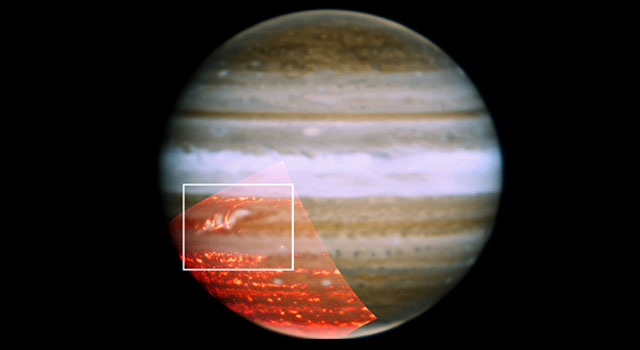
Stripes Are Back in Season on Jupiter


New NASA images support findings that one of Jupiter's stripes that "disappeared" last spring is now showing signs of a comeback. These new observations will help scientists better understand the interaction between Jupiter's winds and cloud chemistry.

Earlier this year, amateur astronomers noticed that a longstanding dark-brown stripe, known as the South Equatorial Belt, just south of Jupiter's equator, had turned white. In early November, amateur astronomer Christopher Go of Cebu City, Philippines, saw an unusually bright spot in the white area that was once the dark stripe. This phenomenon piqued the interest of scientists at NASA's Jet Propulsion Laboratory, Pasadena, Calif., and elsewhere.

After follow-up observations in Hawaii with NASA's Infrared Telescope Facility, the W.M. Keck Observatory and the Gemini Observatory telescope, scientists now believe the vanished dark stripe is making a comeback.

First-glimpse images of the re-appearing stripe are online at: http://www.nasa.gov/topics/solarsystem/features/jupiter20101124-i.html.

"The reason Jupiter seemed to 'lose' this band - camouflaging itself among the surrounding white bands - is that the usual downwelling winds that are dry and keep the region clear of clouds died down," said Glenn Orton, a research scientist at JPL. "One of the things we were looking for in the infrared was evidence that the darker material emerging to the west of the bright spot was actually the start of clearing in the cloud deck, and that is precisely what we saw."

This white cloud deck is made up of white ammonia ice. When the white clouds float at a higher altitude, they obscure the missing brown material, which floats at a lower altitude. Every few decades or so, the South Equatorial Belt turns completely white for perhaps one to three years, an event that has puzzled scientists for decades. This extreme change in appearance has only been seen with the South Equatorial Belt, making it unique to Jupiter and the entire solar system.

The white band wasn't the only change on the big, gaseous planet. At the same time, Jupiter's Great Red Spot became a darker red color. Orton said the color of the spot - a giant storm on Jupiter that is three times the size of Earth and a century or more old - will likely brighten a bit again as the South Equatorial Belt makes its comeback.

The South Equatorial Belt underwent a slight brightening, known as a "fade," just as NASA's New Horizons spacecraft was flying by on its way to Pluto in 2007. Then there was a rapid "revival" of its usual dark color three to four months later. The last full fade and revival was a double-header event, starting with a fade in 1989, revival in 1990, then another fade and revival in 1993. Similar fades and revivals have been captured visually and photographically back to the early 20th century, and they are likely to be a long-term phenomenon in Jupiter's atmosphere.

Scientists are particularly interested in observing this latest event because it's the first time they've been able to use modern instruments to determine the details of the chemical and dynamical changes of this phenomenon. Observing this event carefully may help to refine the scientific questions to be posed by NASA's Juno spacecraft, due to arrive at Jupiter in 2016, and a larger, proposed mission to orbit Jupiter and explore its satellite Europa after 2020.

The event also signifies another close collaboration between professional and amateur astronomers. The amateurs, located worldwide, are often well equipped with instrumentation and are able to track the rapid developments of planets in the solar system. These amateurs are collaborating with professionals to pursue further studies of the changes that are of great value to scientists and researchers everywhere.

"I was fortunate to catch the outburst," said Christopher Go, referring to the first signs that the band was coming back. "I had a meeting that evening and it went late. I caught the outburst just in time as it was rising. Had I imaged earlier, I would not have caught it," he said. Go, who also conducts in the physics department at the University of San Carlos, Cebu City, Philippines, witnessed the disappearance of the stripe earlier this year, and in 2007 he was the first to catch the stripe's return. "I was able to catch it early this time around because I knew exactly what to look for."

NASA's Exoplanet Science Institute at the California Institute of Technology in Pasadena manages time allocation on the Keck telescope for NASA. Caltech manages JPL for NASA.

For more information about NASA and agency programs, visit: http://www.nasa.gov/home.

Tuesday, November 16, 2010

Rocks and Stars with Amy: This Asteroid Inspected by #32

Over the course of the nine months we’ve been operating WISE, we’ve observed over 150,000 asteroids and comets of all different types. We had to pick all of these moving objects out of the hundreds of millions of sources observed all over the sky — so you can imagine that sifting through all those stars and galaxies to find the asteroids is not easy!

We use a lot of techniques to figure out how to distinguish an asteroid from a star or galaxy. Even though just about everything in the universe moves, asteroids are a whole lot closer to us than your average star (and certainly your average galaxy), so they appear to move from place to place in the WISE images over a timescale of minutes, unlike the much more distant stars. It’s almost like watching a pack of cyclists go by in the Tour de France. Also, WISE takes infrared images, which means that cooler objects like asteroids look different than the hotter stars. If you look at the picture below, you can see that the stars appear bright blue, whereas the sole asteroid in the frame appears red. That’s because the asteroid is about room temperature and is therefore much colder than the stars, which are thousands of degrees. Cooler objects will give off more of their light at longer, infrared wavelengths that our WISE telescope sees. We can use both of these unique properties of asteroids — their motion and their bright infrared signatures — to tease them out of the bazillions of stars and galaxies in the WISE images.


Thanks to the efforts of some smart scientists and software engineers, we have a very slick program that automatically searches the images for anything that moves at the longer, infrared wavelengths. With WISE, we take about a dozen or so images of each part of the sky over a couple of days. The system works by throwing out everything that appears again and again in each exposure. What’s left are just the so-called transient sources, the things that don’t stay the same between snapshots. Most of these are cosmic rays — charged particles zooming through space that are either spat out by our sun or burped up from other high-energy processes like supernovae or stars falling into black holes. These cosmic rays hit our detectors, leaving a blip that appears for just a single exposure. Also, really bright objects can leave an after-image on the detectors that can persist for many minutes, just like when you stare at a light bulb and then close your eyes. We have to weed the real asteroid detections out from the cosmic rays and after-images.

The data pipeline is smart enough to catch most of these artifacts and figure out what the real moving objects are. However, if it’s a new asteroid that no one has ever seen before, we have to have a human inspect the set of images and make sure that it’s not just a collection of artifacts that happened to show up at the right place and right time. About 20 percent of the asteroids that we observe appear to be new, and we examine those using a program that we call our quality assurance (QA) system, which lets us rapidly sift through hundreds of candidate asteroids to make sure they’re real. The QA system pops up a set of images of the candidate asteroid, along with a bunch of “before” and “after” images of the same part of the sky. This lets us eliminate any stars that might have been confused for the asteroids. Finally, since the WISE camera takes a picture every 11 seconds, we take a look at the exposures taken immediately before the ones with the candidate asteroid — if the source is really just an after-image persisting after we’ve looked at something bright, it will be there in the previous frame. We’ve had many students — three college students and two very talented high school students — work on asteroid QA. They’ve become real pros at inspecting asteroid candidates!


Meanwhile, the hunt continues — we’re still trekking along through the sky with the two shortest-wavelength infrared bands, now that we’ve run out of the super-cold hydrogen that was keeping two of the four detectors operating. Even though our sensitivity is lower, we’re still observing asteroids and looking for interesting things like nearby brown dwarfs (stars too cold to shine in visible light because they can’t sustain nuclear fusion). Our dedicated team of asteroid inspectors keeps plugging away, keeping the quality of the detections very high so that we leave the best possible legacy when our little telescope’s journey is finally done.

Thursday, November 11, 2010

Cassini Sees Saturn on a Cosmic Dimmer Switch


Like a cosmic lightbulb on a dimmer switch, Saturn emitted gradually less energy each year from 2005 to 2009, according to observations by NASA's Cassini spacecraft. But unlike an ordinary bulb, Saturn's southern hemisphere consistently emitted more energy than its northern one. On top of that, energy levels changed with the seasons and differed from the last time a spacecraft visited Saturn in the early 1980s. These never-before-seen trends came from a detailed analysis of long-term data from the composite infrared spectrometer (CIRS), an instrument built by NASA's Goddard Space Flight Center in Greenbelt, Md., as well as a comparison with earlier data from NASA's Voyager spacecraft. When combined with information about the energy coming to Saturn from the sun, the results could help scientists understand the nature of Saturn's internal heat source.

"The fact that Saturn actually emits more than twice the energy it absorbs from the sun has been a puzzle for many decades now," said Kevin Baines, a Cassini team scientist at NASA's Jet Propulsion Laboratory, Pasadena, Calif., and a co-author on a new paper about Saturn's energy output. "What generates that extra energy? This paper represents the first step in that analysis."

The research, reported this week in the Journal of Geophysical Research-Planets, was led by Liming Li of Cornell University in Ithaca, N.Y. (now at the University of Houston).

"The Cassini CIRS data are very valuable because they give us a nearly complete picture of Saturn," Li said. "This is the only single data set that provides so much information about this planet, and it's the first time that anybody has been able to study the power emitted by one of the giant planets in such detail."

The planets in our solar system lose energy in the form of heat radiation in wavelengths that are invisible to the human eye. The CIRS instrument picks up wavelengths in the thermal infrared region, far enough beyond red light where the wavelengths correspond to heat emission.

"In planetary science, we tend to think of planets as losing power evenly in all directions and at a steady rate," Li said. "Now we know Saturn is not doing that." (Power is the amount of energy emitted per unit of time.)

Instead, Saturn's flow of outgoing energy was lopsided, with its southern hemisphere giving off about one-sixth more energy than the northern one, Li explains. This effect matched Saturn's seasons: during those five Earth-years, it was summer in the southern hemisphere and winter in the northern one. (A season on Saturn lasts about seven Earth-years.) Like Earth, Saturn has these seasons because the planet is tilted on its axis, so one hemisphere receives more energy from the sun and experiences summer, while the other receives less energy and is shrouded in winter. Saturn's equinox, when the sun was directly over the equator, occurred in August 2009.

In the study, Saturn's seasons looked Earth-like in another way: in each hemisphere, its effective temperature, which characterizes its thermal emission to space, started to warm up or cool down as a change of season approached. The effective temperature provides a simple way to track the response of Saturn's atmosphere to the seasonal changes, which is complicated because Saturn's weather is variable and the atmosphere tends to retain heat. Cassini's observations revealed that the effective temperature in the northern hemisphere gradually dropped from 2005 to 2008 and started to warm up again by 2009. In the southern hemisphere, the effective temperature cooled from 2005 to 2009.

The emitted energy for each hemisphere rose and fell along with the effective temperature. Even so, during this five-year period, the planet as a whole seemed to be slowly cooling down and emitting less energy.

To find out if similar changes were happening one Saturn-year ago, the researchers looked at data collected by the Voyager spacecraft in 1980 and 1981 and did not see the imbalance between the southern and northern hemispheres. Instead, the two regions were much more consistent with each other.

Why wouldn't Voyager have seen the same summer-versus-winter difference between the two hemispheres? One explanation is that cloud patterns at depth could have fluctuated, blocking and scattering infrared light differently.

"It's reasonable to think that the changes in Saturn's emitted power are related to cloud cover," says Amy Simon-Miller, who heads the Planetary Systems Laboratory at Goddard and is a co-author on the paper. "As the amount of cloud cover changes, the amount of radiation escaping into space also changes. This might vary during a single season and from one Saturn-year to another. But to fully understand what is happening on Saturn, we will need the other half of the picture: the amount of power being absorbed by the planet."

Scientists will be doing that as a next step by comparing the instrument's findings to data obtained by Cassini's imaging cameras and infrared mapping spectrometer instrument. The spectrometer, in particular, measures the amount of sunlight reflected by Saturn. Because scientists know the total amount of solar energy delivered to Saturn, they can derive the amount of sunlight absorbed by the planet and discern how much heat the planet itself is emitting. These calculations help scientists tackle what the actual source of that warming might be and whether it changes.

Better understanding Saturn's internal heat flow "will significantly deepen our understanding of the weather, internal structure and evolution of Saturn and the other giant planets," Li said.

The Cassini-Huygens mission is a cooperative project of NASA, the European Space Agency, and the Italian Space Agency. NASA's Jet Propulsion Laboratory, Pasadena, Calif., a division of the California Institute of Technology in Pasadena, manages the mission for NASA's Science Mission Directorate, Washington, D.C. The Cassini orbiter and its two onboard cameras were designed, developed and assembled at JPL. The composite infrared spectrometer team is based at NASA Goddard, where the instrument was built.

More Cassini information is available at http://www.nasa.gov/cassini and http://saturn.jpl.nasa.gov .

Friday, October 29, 2010

Dark Reflections in the Southern Cross


NASA's Wide-field Infrared Survey Explorer, or WISE, captured this colorful image of the reflection nebula IRAS 12116-6001. This cloud of interstellar dust cannot be seen directly in visible light, but WISE's detectors observed the nebula at infrared wavelengths.

In images of reflection nebulae taken with visible light, clouds of dust reflect the light of nearby stars. The dust is warmed to relatively cool temperatures by the starlight and glows with infrared light, which WISE can detect. Reflection nebulae are of interest to astronomers because they are often the sites of new star formation.

The bright blue star on the right side of the image is the variable star Epsilon Crucis. In the Bayer system of stellar nomenclature, stars are given names based on their relative brightness within a constellation. The Greek alphabet is used to designate the star's apparent brightness compared to other stars in the same constellation. "Alpha" is the brightest star in the constellation, "beta" the second brightest, and so on. In this case, "epsilon" is the fifth letter of the Greek alphabet, so Epsilon Crucis is the fifth brightest star in the constellation Crux.

Crux is a well-known constellation that can be easily seen by observers in the Southern Hemisphere and from low northern latitudes. Also known as the Southern Cross, Crux is featured in many country's flags, including Australia, Brazil and New Zealand (although New Zealand's flag does not include Epsilon Crucis).

The colors used in this image represent specific wavelengths of infrared light. The blue color of Epsilon Crucis represents light emitted at 3.4 and 4.6 microns. The green-colored star seen beside Epsilon Crucis is emitting light at 12 microns. This star is IRAS 12194-6007, a carbon star that is near the end of its lifecycle. Since the infrared wavelengths emitted by this star are longer than those from Epsilon Crucis, it is cooler. The green and red colors seen in the reflection nebula represent 12- and 22-micron light coming from the nebula's dust grains warmed by nearby stars.

Friday, October 22, 2010

Lunar Impact May Impact Lunar Science For Years To Come


The lunar rocks brought back to Earth by the Apollo astronauts were found to have very little water, and were much drier than rocks on Earth. An explanation for this was that the moon formed billions of years ago in the solar system's turbulent youth, when a Mars-sized planet crashed into Earth. The impact stripped away our planet's outer layer, sending it into orbit. The pieces later coalesced under their own gravity to form our moon. Heat from all this mayhem vaporized most of the water in the lunar material, so the water was lost to space.

However, there was still a chance that water might be found in special places on the moon. Due to the moon's orientation to the sun, scientists theorized that deep craters at the lunar poles would be in permanent shadow and thus extremely cold and able to trap volatile material, like water as ice perhaps delivered there by comet impacts or chemical reactions with hydrogen carried by the solar wind.

In October 9, 2009, NASA's LCROSS (Lunar Crater Remote Observation and Sensing Satellite) was intentionally crashed into the Cabeus crater near the lunar south pole. The idea was to kick up debris from the bottom of the crater so its composition could be analyzed. LCROSS hit at over 9,000 kilometers (5,600 miles) per hour, sending up a plume of material over 19 kilometers (12 miles) high.

"Seeing mostly pure water ice grains in the plume means water ice was somehow delivered or chemical processes are causing ice to accumulate in large quantities," said Anthony Colaprete, LCROSS project scientist and principal investigator at NASA's Ames Research Center, Moffett Field, Calif. "Furthermore, the diversity and abundance of certain materials called volatiles in the plume, suggest a variety of sources, like comets and asteroids, and an active water cycle within the lunar shadows."

LCROSS was a companion mission to NASA's Lunar Reconnaissance Orbiter (LRO) mission. The two missions were designed to work together, and support from LRO was critical to the success of LCROSS. During impact, LRO, which is normally looking at the lunar surface, was tilted toward the horizon so it could observe the plume. Shortly after LCROSS hit the moon, LRO flew past debris and gas from the impact while its instruments collected data.

"LRO assisted LCROSS in two primary ways - selecting the impact site and confirming the LCROSS observations," said Gordon Chin of NASA's Goddard Space Flight Center, Greenbelt, Md., LRO associate project scientist.

"Since observatories on Earth were also planning to view the LCROSS impact, there were a lot of constraints on the location - the impact plume had to rise out of the crater and into sunlight, and it had to be visible from Earth," said Chin.

"Originally, the LCROSS team was going with a site farther north than the Cabeus crater, because it was better for Earth visibility," said Chin. "However, LEND revealed that the area did not have a high hydrogen concentration, but Cabeus did. Also, Diviner showed that Cabeus was one of the coldest sites, and LOLA indicated it was in permanent shadow. So, we were able to influence the decision to aim for Cabeus farther south -- while it was a little less visible from Earth, Cabeus was ultimately better for what we were trying to find."

The Diviner instrument aboard the Lunar Reconnaissance Orbiter was built and is managed by NASA's Jet Propulsion Laboratory in Pasadena, Calif. Temperature maps from LRO's Diviner instrument were also crucial to identify where the coldest places were.

David Paige, principal investigator of the Diviner instrument from the University of California, Los Angeles, used temperature measurements of the lunar south pole obtained by Diviner to model the stability of water ice both at and near the surface.

"The temperatures inside these permanently shadowed craters are even colder than we had expected. Our model results indicate that in these extreme cold conditions, surface deposits of water ice would almost certainly be stable," said Paige, "but perhaps more significantly, these areas are surrounded by much larger permafrost regions where ice could be stable just beneath the surface."

"We conclude that large areas of the lunar south pole are cold enough to trap not only water ice, but other volatile compounds (substances with low boiling points) such as sulfur dioxide, carbon dioxide, formaldehyde, ammonia, methanol, mercury and sodium," Paige added.

A UCLA graduate student and Diviner team member, Paul Hayne, was monitoring the data in real-time as it was sent back from Diviner.

"During the flyby 90 seconds after impact, all seven of Diviner's infrared channels measured an enhanced thermal signal from the crater. The more sensitive of its two solar channels also measured the thermal signal, along with reflected sunlight from the impact plume. Two hours later, the three longest wavelength channels picked up the signal, and after four hours only one channel detected anything above the background temperature."

Scientists were able to learn two things from these measurements: first, they were able to constrain the mass of material that was ejected outwards into space from the impact crater; second, they were able to infer the initial temperature and make estimates about the effects of ice in the soil on the observed cooling behavior.

Another LRO instrument, the Lyman-Alpha Mapping Project (LAMP), used data on the gas cloud to confirm the presence of the gases molecular hydrogen, carbon monoxide and atomic mercury, along with smaller amounts of calcium and magnesium, also in gas form.

"We had hints from Apollo soils and models that the volatiles we see in the impact plume have been long collecting near the moon's polar regions," said Randy Gladstone, LAMP acting principal investigator, of Southwest Research Institute in San Antonio. "Now we have confirmation."

"The detection of mercury in the soil was the biggest surprise, especially that it's in about the same abundance as the water detected by LCROSS," said Kurt Retherford, LAMP team member, also of Southwest Research Institute.

"The observations by the suite of LRO and LCROSS instruments demonstrate the moon has a complex environment that experiences intriguing chemical processes," said Richard Vondrak, LRO project scientist at NASA Goddard. "This knowledge can open doors to new areas of research and exploration."

LCROSS launched with LRO aboard an Atlas V rocket from Cape Canaveral, Fla., on June 18, 2009.

The research was funded by NASA's Exploration Systems Missions Directorate at NASA Headquarters in Washington. LRO was built and is managed by NASA's Goddard Space Flight Center in Greenbelt, Md. LCROSS is managed by NASA's Ames Research Center, Moffett Field, Calif. LAMP was developed by the Southwest Research Institute in San Antonio, Texas; LOLA was built by NASA Goddard; LROC was provided by Arizona State University, Tempe; LEND was provided by Institute for Space Research, Moscow; The Diviner instrument was built and is managed by NASA's Jet Propulsion Laboratory in Pasadena, Calif. UCLA is the home institution of Diviner's principal investigator.

For more information on Diviner, visit: http://diviner.ucla.edu.

Monday, October 11, 2010

Cassini Catches Saturn Moons in Paintball Fight


PASADENA, Calif. – Scientists using data from NASA's Cassini spacecraft have learned that distinctive, colorful bands and splotches embellish the surfaces of Saturn's inner, mid-size moons. The reddish and bluish hues on the icy surfaces of Mimas, Enceladus, Tethys, Dione and Rhea appear to be the aftermath of bombardments large and small.

A paper based on the findings was recently published online in the journal Icarus. In it, scientists describe prominent global patterns that trace the trade routes for material exchange between the moons themselves, an outer ring of Saturn known as the E ring and the planet's magnetic environment. The finding may explain the mysterious Pac-Man thermal pattern on Mimas, found earlier this year by Cassini scientists, said lead author Paul Schenk, who was funded by a Cassini data analysis program grant and is based at the Lunar and Planetary Institute in Houston.

"The beauty of it all is how the satellites behave as a family, recording similar processes and events on their surfaces, each in its own unique way," Schenk said. "I don't think anyone expected that electrons would leave such obvious fingerprints on planetary surfaces, but we see it on several moons, including Mimas, which was once thought to be rather bland."

Schenk and colleagues processed raw images obtained by Cassini's imaging cameras from 2004 to 2009 to produce new, high-resolution global color maps of these five moons. The new maps used camera frames shot through visible-light, ultraviolet and infrared filters which were processed to enhance our views of these moons beyond what could be seen by the human eye.

The new images are available at http://www.nasa.gov/cassini and http://saturn.jpl.nasa.gov .

"The richness of the Cassini data set – visible images, infrared images, ultraviolet images, measurements of the radiation belts – is such that we can finally 'paint a picture' as to how the satellites themselves are 'painted,'" said William B. McKinnon, one of six co-authors on the paper. McKinnon is based at Washington University in St. Louis and was also funded by the Cassini data analysis program.

Icy material sprayed by Enceladus, which makes up the misty E ring, appears to leave a brighter, blue signature. The pattern of bluish material on Enceladus, for example, indicates that the moon is covered by the fallback of its own "breath."

Enceladean spray also appears to splatter the parts of Tethys, Dione and Rhea that run into the spray head-on in their orbits around Saturn. But scientists are still puzzling over why the Enceladean frost on the leading hemisphere of these moons bears a coral-colored, rather than bluish, tint.

On Tethys, Dione and Rhea, darker, rust-colored, reddish hues paint the entire trailing hemisphere, or the side that faces backward in the orbit around Saturn. The reddish hues are thought to be caused by tiny particle strikes from circulating plasma, a gas-like state of matter so hot that atoms split into an ion and an electron, in Saturn's magnetic environment. Tiny, iron-rich "nanoparticles" may also be involved, based on earlier analyses by the Cassini visual and infrared mapping spectrometer team.

Mimas is also touched by the tint of Enceladean spray, but it appears on the trailing side of Mimas. This probably occurs because it orbits inside the path of Enceladus, or closer to Saturn, than Tethys, Dione and Rhea.

In addition, Mimas and Tethys sport a dark, bluish band. The bands match patterns one might expect if the surface were being irradiated by high-energy electrons that drift in a direction opposite to the flow of plasma in the magnetic bubble around Saturn. Scientists are still figuring out exactly what is happening, but the electrons appear to be zapping the Mimas surface in a way that matches the Pac-Man thermal pattern detected by Cassini's composite infrared spectrometer, Schenk said.

Schenk and colleagues also found a unique chain of bluish splotches along the equator of Rhea that re-open the question of whether Rhea ever had a ring around it. The splotches do not seem related to Enceladus, but rather appear where fresh, bluish ice has been exposed on older crater rims. Though Cassini imaging scientists recently reported that they did not see evidence in Cassini images of a ring around Rhea, the authors of this paper suggest the crash of orbiting material, perhaps a ring, to the surface of Rhea in the not-too-distant past could explain the bluish splotches.

"Analyzing the image color ratios is a great way to really enhance the otherwise subtle color variations and make apparent some of the processes at play in the Saturn system," said Amanda Hendrix, Cassini deputy project scientist at NASA's Jet Propulsion Laboratory, Pasadena, Calif. "The Cassini images highlight the importance and potential effects of so-called 'space weathering' that occurs throughout the solar system – on any surface that isn't protected by a thick atmosphere or magnetic field."

The Cassini-Huygens mission is a cooperative project of NASA, the European Space Agency and the Italian Space Agency. JPL, a division of the California Institute of Technology in Pasadena, manages the mission for NASA's Science Mission Directorate, Washington, D.C. The Cassini orbiter and its two onboard cameras were designed, developed and assembled at JPL. The imaging operations center is based at the Space Science Institute in Boulder, Colo.

Wednesday, October 6, 2010

Spiral Extraordinaire

Scientists have yet to discover what caused the strange spiral structure. Nor do they know why it glows. The glow may be caused by light reflected from nearby stars. As for the spiral itself, current supposition is that this is the result of a star in a binary star system entering the planetary nebula phase, when its outer atmosphere is ejected. Given the expansion rate of the spiral gas, a new layer must appear about every 800 years, a close match to the time it takes for the two stars to orbit each other. The above image was taken in near-infrared light by the Hubble Space Telescope.

Friday, September 24, 2010

Cassini Gazes at Veiled Titan


NASA's Cassini spacecraft will swing high over Saturn's moon Titan on Friday, Sept. 24, taking a long, sustained look at the hazy moon. At closest approach, Cassini will fly within 8,175 kilometers (5,080 miles) above the hazy moon's surface. This flyby is the first in a series of high-altitude Titan flybys for Cassini over the next year and a half.

Cassini's composite infrared spectrometer instrument will be probing Titan's stratosphere to learn more about its vertical structure as the seasons change. Equinox, when the sun shone directly over the equator, occurred in August 2009, and the northern hemisphere is now in spring.

Another instrument, the visual and infrared mapping spectrometer, will be mapping an equatorial region known as Belet at a resolution of 5 kilometers (3 miles) per pixel. This mosaic will complement the mosaics that were obtained in earlier Titan flybys in January and April. This spectrometer will also look for clouds at northern mid-latitudes and near the poles.

Cassin's visible-light imaging cameras will also be taking images of Titan's trailing hemisphere, or the side that faces backward as Titan orbits around Saturn. If Titan cooperates and has a cloudy day, scientists plan to analyze the images for cloud patterns.

The Cassini-Huygens mission is a cooperative project of NASA, the European Space Agency and the Italian Space Agency. JPL, a division of the California Institute of Technology in Pasadena, manages the mission for NASA's Science Mission Directorate, Washington, D.C.

Thursday, July 1, 2010

ISS Progress 38 Launches


As the Progress made its way to the orbiting complex Thursday, the Expedition 24 crew members made preparations for its arrival and worked with a variety of science experiments.

Commander Alexander Skvortsov and Flight Engineer Mikhail Kornienko had a conference with specialists on Earth to review docking procedures for the arrival of the Progress.

The Progress is scheduled to dock to the International Space Station using the automated Kurs docking system at 12:58 p.m. Friday.

To make room for the ISS Progress 38, the Expedition 24 crew relocated the Soyuz TMA-19 spacecraft from the aft end of the Zvezda service module to the Rassvet module Monday.

Flight Engineer Doug Wheelock worked with the VO2max experiment, which involves recording the oxygen intake of exercising crew members before, during and after their stays aboard the station to evaluate and document the changes in their aerobic capacity.

Flight Engineer Tracy Caldwell Dyson worked with the Coarsening in Solid-Liquid Mixtures-2 experiment, which studies the way that particles of tin suspended in a molten tin/lead mixture increase in size – a process known as coarsening – without the influence of the Earth’s gravity. This work has direct applications to metal alloy manufacturing on Earth, including materials critical for aerospace applications.


Viewthis site : California Printing,Orange County printing,California Printer,Irvine printing

Friday, June 25, 2010

Earth to Lend Helping Hand to Comet Craft

Earth is a great place to pick up orbital velocity," said Tim Larson, the EPOXI project manager from NASA's Jet Propulsion Laboratory in Pasadena, Calif. "This flyby will give our spacecraft a 1.5-kilometer-per-second [3,470 mph] boost, setting us up to get up close and personal with comet Hartley 2."

EPOXI is an extended mission of the Deep Impact spacecraft. Its name is derived from its two tasked science investigations -- the Deep Impact Extended Investigation (DIXI) and the Extrasolar Planet Observation and Characterization (EPOCh). On Nov. 4, 2010, the mission will conduct an extended flyby of Hartley 2 using all three of the spacecraft's instruments (two telescopes with digital color cameras and an infrared spectrometer).

The University of Maryland is the Principal Investigator institution. JPL manages EPOXI for NASA's Science Mission Directorate, Washington. The spacecraft was built for NASA by Ball Aerospace & Technologies Corp., Boulder, Colo.

Thursday, June 24, 2010

the Orbiting Carbon Observatory.

NASA has selected Orbital Sciences Corp. of Dulles, Va., to launch the Orbiting Carbon Observatory-2 (OCO-2) mission. The spacecraft will fly in February 2013 aboard a Taurus XL 3110 rocket launched from Vandenberg Air Force Base in California.

The total cost of the OCO-2 launch services is approximately $70 million. The estimated cost includes the task ordered launch service for a Taurus XL 3110 rocket, plus additional services under other contracts for payload processing, OCO-2 mission-unique support, launch vehicle integration, and tracking, data and telemetry support.

OCO-2 is NASA's first mission dedicated to studying atmospheric carbon dioxide. Carbon dioxide is the leading human-produced greenhouse gas driving changes in Earth's climate. OCO-2 will provide the first complete picture of human and natural carbon dioxide sources and "sinks," the places where the gas is pulled out of the atmosphere and stored. It will map the global geographic distribution of these sources and sinks and study their changes over time. The OCO-2 spacecraft will replace OCO-1, lost during a launch vehicle failure in 2009.

Thursday, June 17, 2010

New Crew Members Prepare for Docking


Three new Expedition 24 crew members continued their voyage aboard the Soyuz TMA-19 spacecraft to the International Space Station after launching from the Baikonur Cosmodrome in Kazakhstan at 5:35 p.m. EDT Tuesday.

Flight Engineers Doug Wheelock, Shannon Walker and Fyodor Yurchikhin executed another rendezvous burn and tested the docking systems of the Soyuz TMA-19 Wednesday to prepare for docking to the aft port of the station’s Zvezda service module at 6:25 p.m. Thursday.

Fellow Expedition 24 crewmates, Commander Alexander Skvortsov and Flight Engineers Mikhail Kornienko and Tracy Caldwell Dyson, will welcome them aboard the orbiting complex when the hatches open around 9:25 p.m.

Tuesday, May 11, 2010

Herschel Finds a Hole in Space

The dark hole seen in the green cloud at the top of this image was likely carved out by multiple jets and blasts of radiation. The hole was originally thought to be a really dark cloud, but this new infrared picture from the Herschel space observatory and the National Optical Astronomy Observatory on Kitt Peak near Tucson, reveals that the dark spot is actually a gap in a "nest" of gas and dust containing fledgling stars. Herschel's infrared eyes are designed to see into clouds, so the fact that it saw a dark patch of space told astronomers that they were indeed looking at a hole.

The glowing, green cloud around the hole is called NGC 1999. It contains a fairly bright star, called V38O Ori, which is heating up the dust and creating the bright greenish glow. V380 Ori is a triple star system - one of these three stars appears to have launched a jet that helped clear the hole, as well as other jets and stellar radiation.

The red, filamentary glow extending through the middle of the image is a cloud of cold, dense gas and dust -- the raw material from which new stars are forming. Three new, embryonic stars can bee seen as the triangle of orangish, yellow-white spots. Bipolar jets are visible streaming out of one of these stars in blue. The dark region below and to the right of the top orange-white star of the triangle is thought to be another hole carved by jets from the star. This possible hole is not yet lit up by a star, as is the case with the hole seen above it.

Shorter-wavelength infrared light captured by the "NEWFIRM" camera at the National Optical Astronomy Observatory is colored blue, while longer-wavelength infrared light seen by the photodetector array camera and spectrometer instrument on Herschel is green and red.

Herschel is a European Space Agency cornerstone mission, with science instruments provided by consortia of European institutes and with important participation by NASA. NASA's Herschel Project Office is based at NASA's Jet Propulsion Laboratory. JPL contributed mission-enabling technology for two of Herschel's three science instruments. The NASA Herschel Science Center, part of the Infrared Processing and Analysis Center at the California Institute of Technology in Pasadena, supports the United States astronomical community.

Saturday, May 8, 2010

GOES Exploring the Sun's Weather

The series of Geostationary Operational Environmental Satellites known as GOES provide daily satellite images of weather here on Earth, but they also provide scientists with solar data and space weather observations in geosynchronous (over a fixed location on Earth's surface) orbit. NASA has just released a four-minute educational video called "A Weather Satellite Watches the Sun" explaining the uses of space weather instruments on the GOES satellites.

"The GOES space weather instruments provide crucial data for determining the intensity of space weather events reported by forecasters using the National Oceanic and Atmospheric Administration (NOAA) Space Weather Scales," said Howard Singer, Chief Scientist, Space Weather Prediction Center, Boulder, Colo.

The four-minute video was produced by Silvia Stoyanova, a visualizer at NASA's Goddard Space Flight Center in Greenbelt, Md. The video provides information about space weather, interviews with astronaut Paul Richards, NASA GOES Deputy Project Manager Andre' Dress, NOAA's Space Weather Prediction Center Chief Scientist Howard Singer and many others to explain the importance of space weather and monitoring space weather changes.

Thursday, May 6, 2010

Herschel Gets Sneak Peak at Star Birth

The first scientific results from the Herschel infrared space observatory are revealing previously hidden details of star formation. New images show thousands of distant galaxies furiously building stars and beautiful star-forming clouds draped across our Milky Way galaxy. One picture even catches an "impossible" star in the act of formation.

Presented today during a major scientific symposium held at the European Space Agency in the Netherlands, the results challenge old ideas of star birth, and open new roads for future research. The mission is led by the European Space Agency with important participation from NASA.

"Herschel is a new eye on a part of the cosmos that has been dark and buried for a long time," said the mission's NASA project scientist, Paul Goldsmith, at NASA's Jet Propulsion Laboratory, Pasadena, Calif.

Herschel's observation of the star-forming cloud RCW 120 has revealed an embryonic star, which appears ready to turn into one of the biggest and brightest stars in our galaxy within the next few hundred thousand years. It already contains eight to 10 times the mass of the sun and is still surrounded by an additional 2,000 solar masses of gas and dust from which it can feed further.

"This star can only grow bigger," says Annie Zavagno, Laboratoire d'Astrophysique de Marseille in France. Massive stars are rare and short-lived. To catch one during formation presents a golden opportunity to solve a long-standing paradox in astronomy. "According to our current understanding, you should not be able to form stars larger than eight solar masses," says Zavagno.

Tuesday, May 4, 2010

Station Crew Unloads Cargo, Prepares for Shuttle Docking

As aeronautics technology continues to evolve, researchers from government agencies and companies around the globe are trying to answer these questions. Developing and testing technology for planes that produce significantly less noise and have a decreased environmental impact are two of NASA's key research goals.

Flight Engineers Alexander Skvortsov and Mikhail Kornienko continue to unload and inventory the 2.6 tons of food, fuel, oxygen, propellant and supplies delivered by the ISS Progress 37. It docked at 2:30 p.m. EDT Saturday, after Commander Oleg Kotov deftly guided the cargo craft to the Pirs docking compartment using TORU, the Russian telerobotically operated rendezvous system. The manually controlled TORU system was called into play when a jet failure on the Progress forced a shutdown of the Kurs automated rendezvous system.